
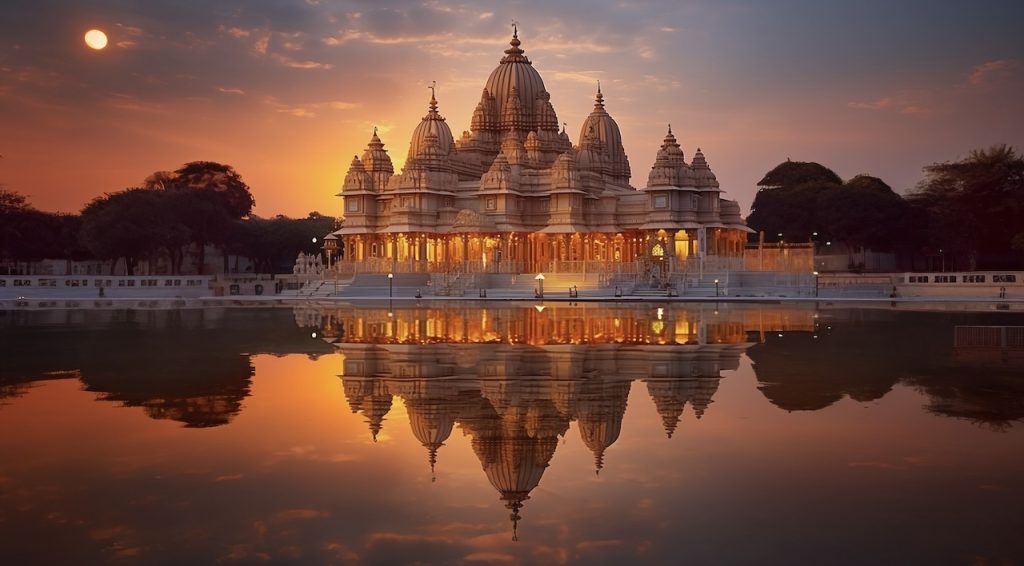
Shree Ram Mandir History
In 1919, the much-loved Maharajah Sumair Singh of Jodhpur, Rajputana passed away in India. In Nairobi, the Marwardis of Rajputana Community, as a sign of their love for the late Maharaja, collected funds and laid the foundation stone of Shree Ram Mandir Marwadi Rajputana Community at Eastleigh, Section III, Nairobi. Shree Ram Mandir was thus born in its first manifestation.
The founder members of the Mandir were Shri Pratapji Bhatti, Shri Khimrajji Gehlot, Shri Jai Singhji, Shri Sohan Singhji, Shri Ganeshji, Shri Peeru Mistry, Shri Johar Singh Thakar, Shri Nathooramji, Shri Lalooji, Shri Bhutaramji and Shri Dhoolamji. Large number of devotees began celebrating all Hindu festivals at Shree Ram Mandir.
The Stri Sabha collected more funds and purchased a vacant plot in front of the temple for its community and humanitarian functions. The Mandir began recording tremendous progress and growth at this time. About 500 children were fed every Sunday and on every religious occasion donations of cloths, food, blankets and utensils were made.
The Stri Sabha gave time and money for every such occasion and efficiently managed the temple with great dedication throughout. The pioneer active members from August 1955 were Smt. Shakuntala Devi Sharma, Smt. Savitri Devi Sharma, Smt. Leela Devi Sharma, Smt. Krishnakumari Sharma, Smt. Hira Devi Bhatti, Smt. Durgaben Parmar, Smt. Kaushlya Rajput, Smt. Veera Devi, Smt. Mayawanti Aggarwal, Smt. Ishwar Devi Aggarwal, Smt. Mohin Galot, Smt. Harbans Chawla, Smt. Bhawari Devi, Smt. Madhya Devi, Smt. Puspha Ratod, Smt. Sushila Devi Bhalla, Smt. Saviti Behal, Smt. Krishna Bhatti and Smt. Brijna Behal.
Growth & Development
As Nairobi developed and grew, its locations and environs witnessed enormous changes. The Mandir’s Managing Committee and Stri Sabha realized the need to relocate the temple to a new site accessible by all Hindu devotees. In 1993 a site was purchased at Bhandari Road, Parklands. The plot at the time comprised of an eight-bedroom house and a large vacant area. The Kumbh Pooja was performed on 28th July 1993. The rooms were demolished and the temple was constructed for installation of idols.
On 21st February 1994, under the Chairmanship of Shri Pravinbhai Dodhia (Batukbhai) the shifting of Temple was made with grand fun fare and rejoicing the shifting of the temple was carried out amidst much fanfare and rejoicing. The Pranprtishta was performed on the next day. It was then realized to develop the vacant part of the plot to provide additional facilities. The Chairman, Managing Committee and Stri Sabha made extensive appeals for funds. Donations in cash and kind started flowing in from devotees and well-wishers. The foundation stone was laid for two underground parking areas, the hall, kitchen, offices second hall on the first floor and priests’ residence. The official opening of the Ram Krishna Hall and Vivek Kutir was performed on 9th November 1997.
Thereafter a comprehensive programme for the temple’s expansion and renovation was initiated. The present new temple was constructed without interruption to a single day’s routine and activities at the temple. The temple is constructed on 16 pillars for which appropriate ceremonies were performed by the families of devotees and well-wishers. Stri Sabha performed the official door opening ceremony of the renovated Temple on 21st April 2002
Mandir As We See It Today
Shree Ram Mandir today is a well-known and spacious temple having idols of most Hindu deities i.e. Lord Shree Ganeshji, Shree Ram Pariwar, Shree Hanumanji, Shree Radha Krishna, Shree Ambe Maa, Shree Gayatri Maa, Shree Mahavir Swami, Shree Lakshmi Narayan, Shree Jalaram, Shee Ramdev Pir, Shree Sai Baba, Shree Garudji, Shree Shiva Linga, Shree Ganga Mata, Shree Shitla Mataji, Shree Dattatrey, Shree Baliya Dev, Shree Nag Dev, Shree Shankar Parvati Parivar and Gau Mata. Near the Havan Kund, the Pranpratista of a small and beautiful new temple dedicated to Lord Ayyappa was performed on 26th May 2002. This is the first temple of its kind on the African Continent. The Ram Krishna Hall is a large spacious function hall, is served by two levels of underground parking, fully equipped modern kitchen, apparatus and vessels. The other small hall is on the first floor together with residential facilities for priests and visiting sages.
The Mandir performs Shree Hanuman Chalisa every Saturday when large number of devotees chants the holy names of Shree Hanumanji; the function is always followed by maha prasad. The Stri Sabha holds Ladies’ Satsang every Monday, Sunderkand Paths every Tuesday and Jalaram Satsang every Thursday. The Stri Sabha also visits individual residences for satsangs whenever requested by devotees.
The major festivals celebrated are Diwali & New Year, Makar Sankranti, Maha Shiv Ratri, Holi, Ram Navmi, Hanuman Jayanti, Janmastmi, Navrarti and Dussera, The Dussera festival is celebrated in lively fashion where devotees dressed as Lord Ram, Laxman and Hanumanji grant Darshan. The Ram Krishna Hall is the place for Navratri Celebration every year. Satsangs are also held during the nine days of Navratri
The funds obtained from the disposal of the Eastleigh plots were used to purchase residential property on Desai Road. Today these Shree Ram Mandir Flats are in great demand by small families. The Mandir serves the community and less fortunate members of the society by regularly donating food, milk, medicines and other essential commodities.